Already own a station?
Compare the panel-only options above. Check the exact model, charging lead and included accessories before adding a separate cable to your order.
BUYING GUIDE
A phone and a refrigerator need very different backups. Write down the job before comparing the battery.
01
Can the unit support your device and its starting demand?
02
How much stored energy is available for the planned use?
03
How will you replenish it during the interruption?
Phone charging with compatible connections.
10,000mAh · USB onlyAn outlet for a load you have checked.
286Wh · 600W ratedMore stored energy and rated output.
1,024Wh · 1,800W ratedManufacturer-rated specifications. These are equipment categories, not a guarantee of runtime or appliance compatibility.
| Option | A useful starting task | What to check |
|---|---|---|
| USB power bank | Charging phones and compatible USB devices. | Port, cable, charging protocol and output. A USB bank is not an AC appliance supply. |
| Portable power station | Compatible AC or DC equipment. | Continuous output, starting surge, watt-hours, connections and manufacturer instructions. |
| Fuel generator | Longer-running loads where a safe outdoor setup is possible. | Outdoor placement, fuel, maintenance, electrical connection and noise. It is not an indoor option. Compare portable and whole-home backup approaches. |
Choose one option for each job you need covered. Tiers describe relative spending within that comparison, not a quality or safety guarantee. Reference prices, where shown, were checked September 11, 2026 before tax and shipping; they are not live Amazon prices. Sales and bundles can change the order.
A phone-size bank, a lightweight outdoor bank and a larger laptop-capable bank cover different carrying and charging priorities. None has an AC outlet.
| Product and tier | Why consider it | Tradeoff |
|---|---|---|
Budget 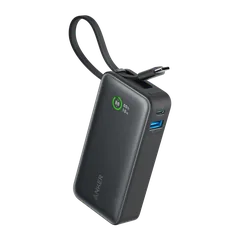 Anker Nano A1259 (opens in a new tab) | A compact phone backup with a built-in USB-C cable, useful if that connection fits your device. | No AC outlet. Shared-port output is limited to 24W; do not assume 30W to every device. |
Midrange · $83.95 at review  Nitecore NB10000 Gen 4 (opens in a new tab) | A 10,000mAh power bank aimed at keeping carrying weight low. | Choose Gen 4, not Gen 2 or a headlamp bundle. Less stored energy than a 25,000mAh bank; no AC outlet. |
Premium · $119.99 at review  Anker Laptop Power Bank A1695, 25K / 165W (opens in a new tab) | More stored energy and built-in plus retractable USB-C cables for phones and compatible laptops. | 165W is shared total output, not output to every port. Heavier than a phone-size bank; device and cable compatibility still matter. |
Start with the device load and required runtime. Extra money buys output or stored energy; it does not make a station suitable for every appliance. Solar panels are separate.
| Product and tier | Why consider it | Tradeoff |
|---|---|---|
Budget · $249.00 at review  Jackery Explorer 240 v2, US version (opens in a new tab) | A 256Wh LiFePO4 station with 300W rated AC output for defined small loads. | Not the older Explorer 240. Limited capacity; solar charging requires the specified adapter. Buy the station, not a refurbished listing or panel bundle. |
Midrange  EcoFlow RIVER 3 Plus (opens in a new tab) | A compact step up when you have a defined small load that needs an AC outlet. | Capacity is limited. The 1,200W X-Boost claim is not its standard rated output. |
Premium  EcoFlow DELTA 3 Plus (opens in a new tab) | Consider it when your verified load and intended use time exceed a small station’s capabilities. | About 27.6 lb. Appliance starting demand and actual runtime still need checking. |
These panels charge compatible equipment; they do not store electricity. Match voltage, current limits, connectors and cables before buying. Larger rated output needs more space and useful sunlight.
| Product and tier | Why consider it | Tradeoff |
|---|---|---|
Budget  EcoFlow 45W Portable Solar Panel (Type-C) (opens in a new tab) | Compact panel with the selected Type-C connection option. | Low rated output; confirm the exact ports and supplied cable. |
Midrange · $259.00 at review  EcoFlow 110W portable solar panel (opens in a new tab) | A folding panel between the smaller 45W and larger 220W options for a compatible power station. | Check input voltage, connector and required cable against your station. Rated wattage is not guaranteed real-world output; panel stores no energy. |
Premium  EcoFlow NextGen 220W Portable Solar Panel (opens in a new tab) | A larger folding panel for compatible stations with sufficient solar input capacity. | Non-bifacial EFSOLAR220W-NS; larger and heavier than the smaller panels. |
Models and features reviewed against manufacturer information on September 11, 2026. These are researched choices, not hands-on tests. Check the current product page for exact contents, fit and availability. Affiliate disclosure.
A panel can replenish stored energy when you have usable sunlight. It does not increase the station’s battery capacity or AC output. Start with a charged station; cloudy days and shade can substantially reduce replenishment.
| Your station | Panel option | Why consider it | Connection and package check |
|---|---|---|---|
| RIVER 3 Plus | EcoFlow 45W Portable Solar Panel (Type-C) | Compact option for modest replenishment. Much slower than a 220W panel. | The Type-C model’s solar output uses DC5521; its USB-C output is only 15W. The linked Amazon listing includes a DC5521-to-XT60i charging cable for the station’s solar input. Do not assume a USB-C cable charges the RIVER. |
| RIVER 3 Plus or DELTA 3 Plus | EcoFlow NextGen 220W Portable Solar Panel Model EFSOLAR220W-NS | Higher-rated collection for the RIVER, or a single-panel starting point for the DELTA. Requires more setup space. | The linked Amazon listing includes a solar-to-XT60i charging cable and panel bag. This listing is the EFSOLAR220W-NS version; no rear-side output is included in our comparison. Confirm the selected model and box contents with the seller. |
The RIVER 3 Plus accepts up to 220W solar input. The DELTA 3 Plus has two solar inputs rated up to 500W each; a single 220W panel will not deliver the station’s advertised maximum charging speed. These selections use manufacturer specifications, not our own testing.
Compare the panel-only options above. Check the exact model, charging lead and included accessories before adding a separate cable to your order.
Compare the total cost of a station, panel and required cable against a solar kit. Choose the exact station and panel variant; a “solar generator” title alone does not confirm package contents.
Use the exact tracked Amazon station and panel links on this guide; confirm every bundle component before ordering.
Use the station’s designated solar input and manufacturer-approved wiring. Connector fit alone does not establish electrical compatibility. Check voltage, current and polarity in the exact model’s instructions, particularly before combining panels. Keep the station dry and within its operating-temperature limits; a panel’s weather rating does not apply to the station.
For planning, 100W actually reaching the station for three hours is 300Wh before storage losses and any equipment running at the same time. This is an arithmetic example, not a forecast for either panel.
Solar sources checked September 10, 2026: the linked Amazon product listings and EcoFlow manufacturer pages. As an Amazon Associate I earn from qualifying purchases. Manufacturer links are ordinary reference links. Seller availability, selected variants and box contents can change.
WATTS · W
Output is the power available at one time. Check both running demand and starting surge for motor-driven appliances.
WATT-HOURS · Wh
Capacity describes stored energy. Actual runtime also depends on load, conversion losses, temperature, and battery condition.
Sources: EcoFlow: understanding power output (manufacturer guidance) ↗
For a constant, noncritical load. First confirm the battery can supply its running and starting power.
500 Wh × 80% ÷ 50 W. The 80% value is an illustrative assumption, not a product specification.
This arithmetic is an estimate, not a guarantee or device-compatibility check. It does not model changing loads, startup surges, or solar charging. Do not use it to plan life-support or essential medical backup.
BUDGET APPROACH
If charging small USB devices is your actual need, begin with a compatible bank. Check connections before adding capacity.
USEFUL UPGRADE
Consider a power station after listing the device, required output, expected use time, and a way to recharge during an extended outage.
For medical devices, use the care team’s and manufacturer’s approved backup plan. An ordinary runtime calculation cannot establish suitability.
Possibly, if the exact model supports both the running load and compressor startup. Runtime depends on actual cycling and conditions. Check appliance and battery specifications rather than assuming the capacity number answers both questions.
Powering your router only covers your end of the connection. Service can still fail elsewhere. Keep another way to receive official information.
Compare solar add-ons and package options above. Weather and available daylight affect charging; a panel is not a promise of daily replenishment.
Recommendations use manufacturer specifications and the tasks described above. We have not personally tested these products or independently verified Amazon prices and stock. Manufacturer specifications are separate from independent safety guidance.
Sources checked September 9, 2026. Prepared by Survivor Ready, an independent resource created by Chris McGuire. AI assists drafting and illustrative imagery. This page has not received independent expert review. Follow local emergency instructions and individual professional advice.
Check chargers, cables and the devices you need to support.
FILLCover lighting and phone charging in your outage plan.
UPGRADECompare capacity against your device loads, not a marketing label.
A way to set priorities, not a readiness score. Essential needs can require purchases or professional help.

Power & light
A charged power bank is only part of the setup. Try the actual phone, cable and port together before you need them.