Go-bags & evacuation
What six emergency-kit listings tell you about food and water
A documented review of six exact kit configurations, separating filled water, containers, treatment tools and unresolved food-label details.
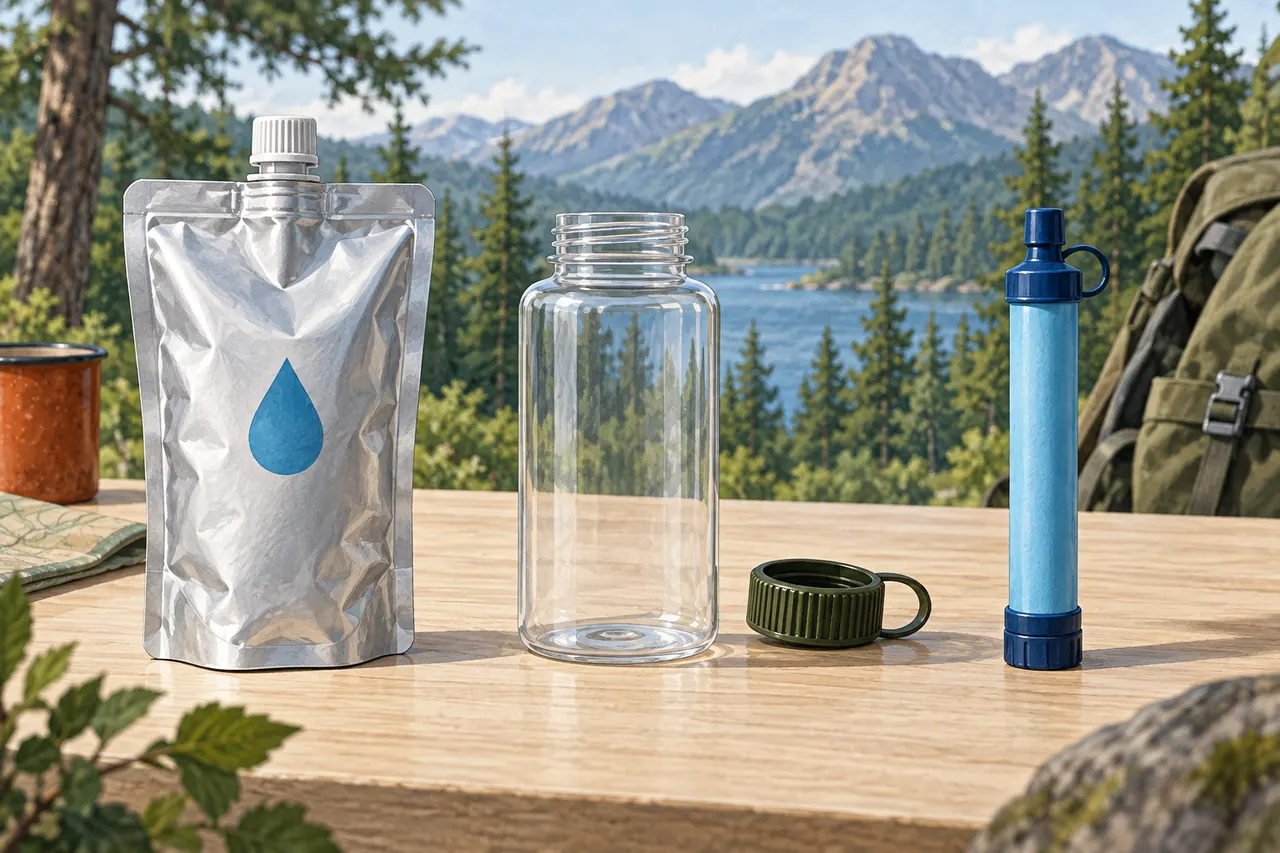
What we reviewed
An emergency backpack can make it easier to get started. Comparing the contents is less straightforward: a filled pouch, an empty bottle and a filter are all water-related items, but they do different jobs.
We reviewed the manufacturer listings for the six current kits in Survivor Ready’s premade-bag comparison. This is a documented listing review, not a physical inspection, product test or representative survey of the market. We did not verify sales rankings, so these are not described as the six best-selling kits.
FILLED WATER
A supply
Water already supplied in a sealed pouch or carton.
EMPTY BOTTLE
A container
Capacity to hold water. An empty bottle adds no stored water.
FILTER
A treatment tool
Requires a suitable source and use according to its instructions.
Download the evidence table
Download the six-kit data table (CSV) and read the method and field definitions (TXT). Missing numbers are left blank. Each row retains its source, configuration, date and uncertainty notes.
Compare like with like
| Exact configuration | Advertised people | Filled water listed | Treatment or container, separately | Food energy established from listing |
|---|---|---|---|---|
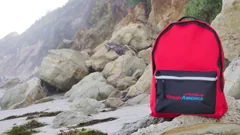 Ready America 70280 (opens in a new tab) | 2 | 12 pouches labeled 4.225 oz each; approximately 1.50 L under the fluid-ounce assumption below | No treatment tool identified in the inventory reviewed | 2 × 2,400-calorie bars = 4,800 calories |
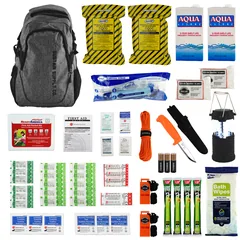 Sustain Supply Essential 2, 70490 (opens in a new tab) | 2 | 2 × 1 L cartons = 2 L | 1 filter straw | 2 × 2,400-calorie bars = 4,800 calories |
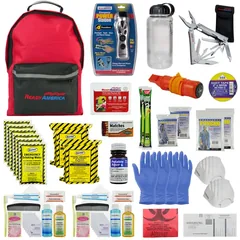 Ready America Deluxe 70285 (opens in a new tab) | 2 | 6 pouches labeled 4.225 oz each; approximately 0.75 L under the same assumption | Treatment tablets and a 32 oz bottle; bottle capacity is not counted as supplied water | 2 × 2,400-calorie bars = 4,800 calories |
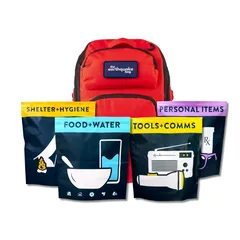 Redfora Ready For Anything, 1 person / 3 days / red backpack (opens in a new tab) | 1 | 12 pouches; pouch volume not established in this configuration’s inventory | 1 filter straw | 1 bar labeled 3,600 calories |
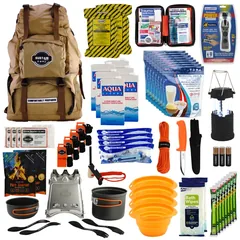 Sustain Supply Comfort 4, 70492 (opens in a new tab) | 4 | 6 × 1 L cartons = 6 L | 4 filter straws | 4,800 calories in bars, plus 8 creamy-chicken meal kits whose total calories are not established here |
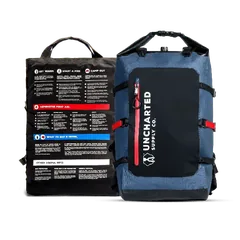 Uncharted SEVENTY2.0 Pro, current Barron-backpack version (opens in a new tab) | 2 | No filled water identified in the inventory reviewed | Water bottle and filtration system | 2 food packs listed; current total calories not established |
Conversion note: The Ready America pouch inventories say “oz,” without explicitly writing “US fluid ounces.” Approximate liters above assume US fluid ounces for this liquid product. The count and labeled ounce size are directly listed; the unit interpretation is an analytical assumption requiring label or manufacturer confirmation. Keep this footnote attached to those quantities in any reuse.
“No filled water identified” describes the page reviewed. It does not establish what every delivered package contains. “Not established” is not zero. Product substitutions, regional versions and configuration choices can change an inventory.
Liters supplied per complete kit · common scale 0 to 6 L
Three useful findings
A more elaborate kit does not necessarily list more filled water. In this pair, the Deluxe 70285 lists six same-size pouches while the simpler 70280 lists twelve. The Deluxe also lists treatment tablets and a bottle. That is a difference in the type of supplies, not a complete verdict on either product.
An item count can hide an unanswered question. Twelve water pouches do not establish liters without a pouch size. Eight meal kits do not establish total calories without the relevant labels. Ask about the exact configuration you plan to buy.
A bag and a household reserve are different parts of the plan. CDC recommends storing at least one gallon per person per day for three days, for drinking and other uses. For two people, that is six US gallons, approximately 22.7 L. This is a household storage benchmark, not an instruction to carry that amount in one backpack or a test of whether a carried kit “passes.” CDC emergency water guidance.
What to do before buying
Write down who the kit is for, where it will be kept and how it would travel. Then check filled water, food labels, preparation requirements and personal additions. A treatment tool should prompt a separate question about a suitable source and the tool’s instructions; it does not add stored water to the bag.
Our comparison does not calculate a safe survival duration, nutritional adequacy or medical suitability. Those cannot be established from a simple inventory table. Use the full go-bag planning guide and household water guide to develop the wider plan.
Commercial disclosure
Survivor Ready earns commissions from some shopping links elsewhere on the site. The manufacturer links in this study are sources, without affiliate tracking. No manufacturer has paid for this study. The review uses AI-assisted research and drafting; no hands-on testing is claimed.
How to reproduce this comparison
- Freeze the sample: the six active configurations already included in our premade-bag comparison, selected before this analysis. This is a convenience sample. Four listings are from Ready America’s site; the sample is not six independent manufacturers and is not representative of the whole category.
- Identify the version: retain manufacturer, SKU where available, number of people and configuration. Exclude the older Uncharted Pro retailer listing from this study because it does not establish the current Barron-pack contents.
- Record the source date: manufacturer pages retrieved September 11, 2026. This is retrieval evidence, not confirmation of purchase availability, seller accuracy or delivered contents. No complete archived page capture is included; linked pages may change.
- Extract only relevant fields: filled-water count and unit; treatment equipment; container capacity; food count and declared energy; unresolved fields. Do not infer a component from a picture or transfer labels between similar models.
- Keep three evidence levels: directly listed facts; arithmetic/explicit assumptions; unresolved details. An empty numeric field remains missing rather than zero.
- Calculate transparently: count × per-unit quantity; use liters for listed liter products. For the two ounce-labeled inventories, retain the original quantity and conditional conversion. Do not produce a calories-per-day adequacy score.
- Avoid market-wide conclusions: no statistical averages, “best” ranking, success rates or survival-duration scores. Do not combine the unknown entries into an average.
- Correct by configuration: record future corrections with date, source, changed value and reason. Manufacturer replies should be attributed. A later hands-on inspection is a separate evidence layer with its own date and exact received model.
Calculation record
| Calculation | Result | Interpretation |
|---|---|---|
| 12 × 4.225 × 0.0295735295625 | 1.49938 L | Conditional on interpreting labeled oz as US fluid ounces |
| 6 × 4.225 × 0.0295735295625 | 0.74969 L | Same assumption |
| 2 × 1 L | 2 L | Listed liter quantities |
| 6 × 1 L | 6 L | Listed liter quantities |
| 2 × 2,400 calories | 4,800 calories | Declared bar energy only |
| 2 people × 3 days × 3.785411784 L | 22.71247 L | Conversion of the CDC household-storage benchmark |
Sources checked September 11, 2026. General preparedness information, not individualized emergency or medical advice. Follow current local instructions. Our editorial approach.